
O.M-R. – Almost a decade ago, I interviewed Szilvia Malik about Orbán’s rise and consolidation in power in Hungary. Today, in an in-depth email exchange, I resume that conversation.
Szilvia is Hungarian, born in 1980, and has lived abroad —in the United States, Denmark, Australia, and now France— for most of her adult life. Since we last spoke, Hungary has undergone what once seemed improbable: the fall of Víktor Orbán, who had dominated its politics for over a decade. His successor, Péter Magyar —a former Fidesz insider turned opposition leader— rose to the premiership within roughly two years, propelled by a public scandal that many Hungarians experienced as a breaking point. His party, Tisza, now governs a country attempting something rare within the EU: rebuilding democratic institutions and trust with Brussels after years of illiberal rule. I ask Szilvia what this transition looks like from the inside, and whether she is any closer to going home.
When we spoke in 2018, you described Hungarian society as an «untamed horse» onto which a populist politician like Viktor Orbán had successfully jumped. Looking back today, do you still think that image captures what happened in Hungary from the 2010s?
I think that when I compared Hungarian society to an untamed horse, what I meant was that it was a nation armed with historical grievances and nationalist sentiments, and Orbán was skilled enough to ride that horse for almost two decades. However, under its master’s rule, the horse gradually became an exhausted and abused nag.
Over the years, Orbán’s system was nicknamed the System of Narcissistic Cooperation (instead of its official name, the System of National Cooperation). The government seemed to develop a narcissistic relationship with the public, in which psychological manipulation played a central role. Through gaslighting, propaganda, and the constant manufacturing of enemies, it conditioned many people to accept its narrative and helped prolong its hold on power.
To be honest, I did not think this trajectory could be reversed as the country sank deeper into corruption, destitution, and a coarse, contempt-driven public discourse.
Yet, rather ironically, just as Orbán once recognized an opportunity to tame the untamed horse, Magyar emerged at precisely the right moment to rescue the weary nag: both sensed the mood of the nation and arrived when people were yearning for change. The difference is that while Orbán harnessed the horse’s energy to consolidate his own power, Magyar presents himself as someone trying to restore its strength and allow it to run freely again.
For years, Orbán appeared electorally unbeatable. Has Hungarian society changed, or is it the political system that has changed?
People were slowly starting to have enough. The entire country was covered with ridiculously absurd war-propaganda billboards. Fearmongering was a constant part of everyday life. Children began asking their parents whether there would be a war and their older brothers might one day become soldiers.
Ironically, it was the vulnerability of children that helped change the situation. In February 2024, a major scandal erupted when it became public that a convicted offender connected to a children’s home had received a presidential pardon. The pardon had been approved by the Minister of Justice and the President of Hungary, both of whom were women. Hungarian society had reached its breaking point.
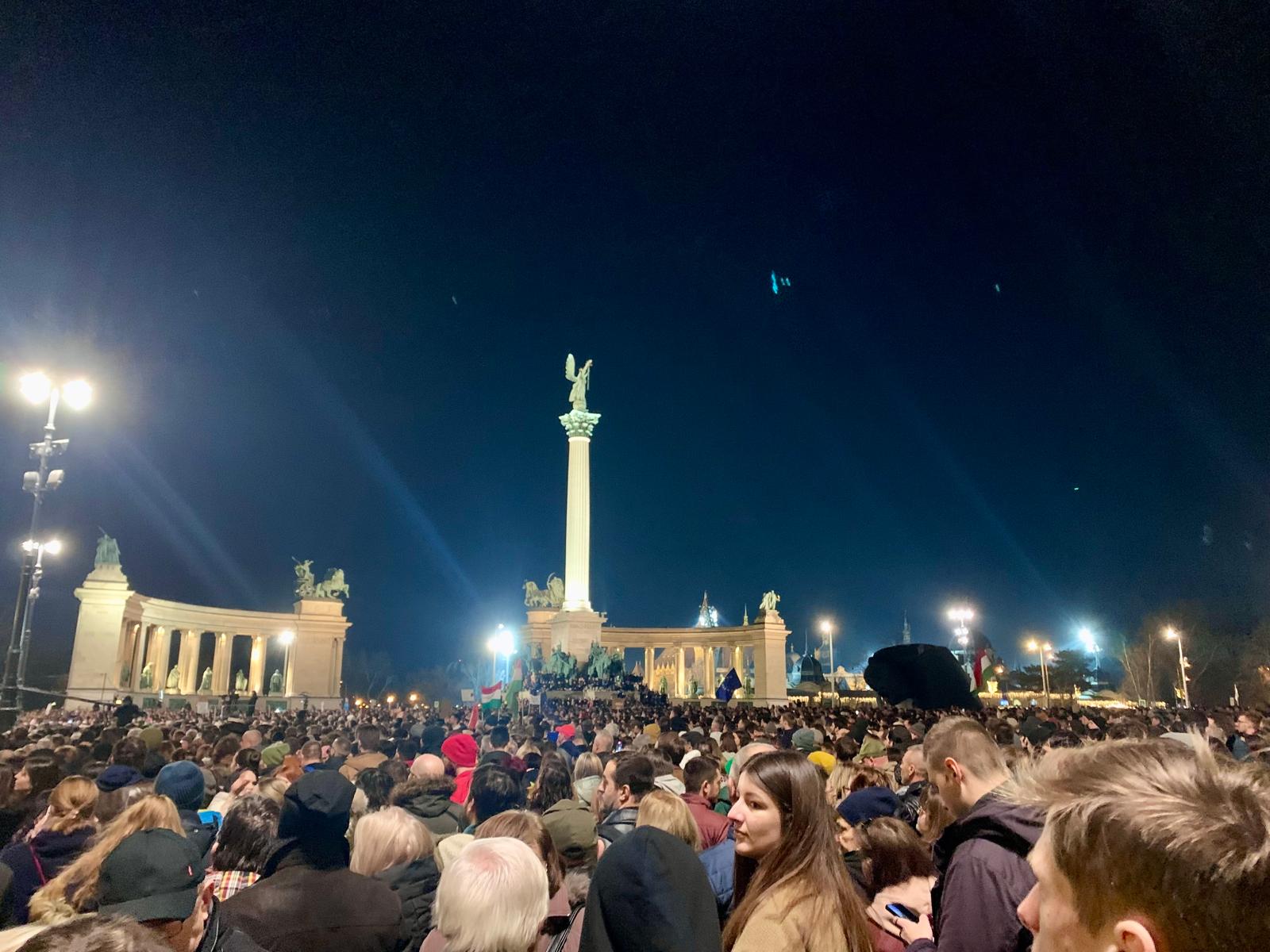
I attended the demonstration organized by Hungarian influencers in protest against this decision, and the atmosphere was eerie. A massive, but silent crowd filled Heroes’ Square. There was anger, disappointment, sadness, frustration… but something was missing: a leader.
It felt as though, if someone had stepped onto that stage and offered direction, the crowd would have followed. But there was no one and the crowd dispersed in a depressed state.
Péter Magyar appeared shortly afterward. He sensed the same vacuum in the political arena. He took to Facebook on 10 February 2024 and wrote a post that is now widely regarded as the moment when Magyar publicly broke with Fidesz and began his transformation from a political insider into Orbán’s most significant challenger.
On that day President Katalin Novák and former Justice Minister Judit Varga (Magyar’s then already ex-wife and mother of their three children) resigned over the clemency scandal. In that post, Magyar announced his resignation from positions at state-linked organizations and declared that he did not want to remain part of a system «where the real responsible parties hide behind women’s skirts.»
What followed was a remarkably rapid political rise.
What does Péter Magyar represent in Hungarian politics? A break with the Orbán era, a correction of its excesses, or something else?
Personally, I find Magyar a fascinating figure. He has become something of a blank canvas onto which different parts of the political spectrum project their own hopes, fears, and expectations about change.
For some, he is a product of the right whose disillusionment with the excesses of the Orbán regime eventually led him to break with it. For others, he resembles a figure from Hungarian folk tales: the young geese-shepherd (Ludas Matyi) who rises up and defeats the tyrant. For his critics, however, he is a traitor who turned against the very system that nurtured both him and his family, having been a supporter of Fidesz for many years.
Nevertheless, it is important to note that Magyar is still very much of a right-wing politician with plenty of national sentiments, who surrounded himself with people from various political backgrounds. His critics tend to ask, how will this government function representing so many schools of thought?
For me, however, Magyar is above all the person who was able to bring down the system. He possessed many of the qualities necessary to dismantle it, as he himself often promised to do, «brick by brick.» He had the stamina, determination, boldness, ruthlessness, and courage required for such a task. And most importantly he had the endurance to perform monotone tasks such as visiting several hundreds towns and villages and repeating the same speeches during two years of campaign. He may not be an easy or universally likeable character, but he was the kind of character capable of taking on that challenge.
Perhaps his greatest advantage was that he knew the Orbán system from the inside and therefore knew how to protect himself against it. Time and again, he seemed able to stay one step ahead of the attacks directed at him.
It remains to be seen whether he will develop into a great politician, a respected statesman, or simply the man who brought an era to an end.
To what extent was Orbánism dependent on Viktor Orbán himself? Can the political culture he created somehow survive his electoral defeat?
According to the latest polls about two thirds of the eligible voters think that the country is going into the right direction. It was also recently reported that more and more Fidesz voters would now vote for Tisza.
Let’s face it, Fidesz was largely Orbán. Now that he has left the Parliament, his party members struggle as a minority party. They act like a flock without its shepherd. However, there remain many devoted voters, and their faith in Orbán will not disappear overnight. Everything that comes to light regarding corruption, propaganda, and so on won’t matter much to many because admitting such evidence would create cognitive dissonance, so they are inclined to rationalize it away rather than change their views.
The political culture of Orban is still around, mostly in people’s heads and discourse. Those who supported him are still extremely critical, sceptical of everything else.
Much has been written about democratic backsliding. What are we learning about the opposite process? How difficult is it to rebuild institutions after more than a decade of undemocratic political control?
It is probably as challenging as it is exciting. It is rare, if not unprecedented, for a European Union member state to have to rebuild democratic institutions and restore democratic norms after operating for years under what many have described as an illiberal system. So far, however, the first steps appear to be moving in the right direction: limiting the long-term concentration of power, strengthening independent oversight, improving transparency, combating corruption, and making institutions less dependent on a single political leader or party.
The Tisza government has announced plans to establish a new institution to support the anti-corruption work: the National Asset Recovery and Protection Office. This independent body would be accountable only to Parliament and would be granted broad investigative and asset-recovery powers to trace, recover, and prevent the alleged misappropriation of an estimated 30 trillion forints in public assets lost through corruption and unlawful transactions over the past two decades.
Within Parliament, the government has voted to reduce the salaries of Members of Parliament and to introduce term limits for elected officials, including the prime minister. Under the new rules, a prime minister may serve a maximum of eight years. The intention is to prevent the emergence of a political system in which a single leader can remain in power for decades, as Viktor Orbán did.
There are also plans to create a fairer electoral system designed to reduce the likelihood of future governments obtaining overwhelming parliamentary supermajorities. Both Tisza and, before it, Fidesz governed with two-thirds majorities, allowing them to pass virtually any legislation and amend the constitution with limited parliamentary opposition.
In addition, Hungary is in the process of joining the European Public Prosecutor’s Office (EPPO), which is expected to strengthen oversight of EU funds and help ensure that European taxpayers’ money is spent appropriately.
The Council of the European Union has also approved Hungary’s recovery plan, making up to €10 billion available to the country, including approximately €6.5 billion in grants and €3.5 billion in loans. To access these funds, Hungary must implement a series of agreed reforms and investment projects. The funding will be provided through the EU’s post-pandemic recovery programme, NextGenerationEU.
Have you seen meaningful changes in Hungary’s media landscape in this process, especially since the change of government?
Yes. The Government proposed and subsequently passed legislation to replace the old public media structure. The state news agency, MTI, was separated into an independent organization with its own budget and governance framework.
The main outlets of the former propaganda apparatus have gradually been deprived of state funding. Some have struggled to adapt to the new environment; for example, Mandiner has reportedly been forced to rent out parts of its studio facilities to generate additional revenue.
Hungary’s public television and radio services suspended their regular news broadcasts and issued a statement that read:
«Public media should not lie. We apologize for having done so for many years. Public media is currently being reformed so that it can become independent and trustworthy in the future. News services are temporarily suspended. Please stay with us.»
The Hungarian public radio channel Kossuth Rádió announced that it would broadcast only classical music until its news and current affairs programming could be reorganized under the new public-service model.
When I was home in July, I turned on the public radio in the car, and I must admit I felt stressed listening to it. But surprisingly there were only dry news, nothing distorted, so my body slowly started to relax during the ride.
Hungary spent years challenging the liberal consensus within the European Union. How is Hungary redefining its place in Europe today?
One of the first things the new government did immediately after its inauguration ceremony was to restore the European Union flag to the Parliament building, after it had been removed in 2012. For me, this was a particularly significant moment, as I was working for the European Parliament when the flag was first raised during the country’s accession to the EU. Seeing it return felt symbolic: a clear signal that Hungary had found its way back to Europe.
Shortly afterward, Péter Magyar and his team succeeded in negotiating with the European Union to unlock substantial funding for Hungary that had previously been frozen. This was widely viewed as an important step toward rebuilding trust between Hungary and its European partners.
Politically, Tisza has sought to position itself as a centre-right party committed to European values. Its stated goal is not only to improve relations with the European Union but also to rebuild and strengthen Hungary’s democratic institutions. Only time will tell whether they will succeed.
National identity played a central role in Orbán’s political project. Do you think that emphasis on nationhood has been weakened by the political transition, or has it become a lasting feature of Hungarian public life?
National identity remains very important to Magyar and the new Tisza government. In fact, without a strong emphasis on national identity, it would have been impossible for Tisza to win over such a large share of Orbán’s former supporters. The Hungarian tricolour flag has been a prominent feature at rallies and national celebrations.
In many ways, this has been an attempt to reclaim national symbols from Fidesz, which for years had presented itself as the sole representative of the nation and had effectively appropriated the language and imagery of patriotism.
At the same time, the meaning of being Hungarian is being redefined. Under Tisza, national identity is no longer presented as being in opposition to Europe or liberal democracy. Instead, the government has sought to promote an understanding of Hungarian identity that is both patriotic and European, embracing national traditions and sovereignty while remaining committed to democratic values, the rule of law, and European cooperation. Also, Magyar’s first trip was to Poland as a prime minister, which was the first signal that the government is trying to strengthen its Visegrad identity as well.
When we last spoke, you described your life abroad as a form of voluntary exile. Do you still feel that way? Has the political change in Hungary affected your relationship with the idea of returning home?
Although my personal life choices influenced my decision to leave Hungary, I also believe that the fact that the Orbán regime remained in power for two decades affected my decision to stay abroad and not seriously consider moving back home. Two media outlets that I freelanced for were shut down during this period, and I have often felt that, as someone who works with the Hungarian language, I was deprived of opportunities that instead went to people with connections to the Orbán circle.
Since the change of government, we have definitely started to flirt with the idea of moving back to Hungary, at least for a year. However, I would like to wait a little longer—until the divide between the political left and right becomes less pronounced than it is today, and until the new government’s reforms have had time to take root and produce visible results.
Most of all, I would like to see a Hungary where public discourse is less polarized and less fuelled by hatred; where people can engage with one another without constant hostility and suspicion. Whether that will happen anytime soon remains uncertain. Perhaps, for that, we will have to wait a little longer.
Interview by Olivia Muñoz-Rojas

